
2026 Lifeline Income Limits by Household Size (All 50 States)
By Arthur Patch · Last verified July 2026 · Sources: USAC and HHS
Lifeline sets its income gate at 135% of the Federal Poverty Guidelines. That figure changes every year; it changes with the number of people in your household, and it is different in Alaska and Hawaii. This page gives you the current numbers and, just as importantly, explains how the income is counted — which is where most people get their own answer wrong.
For 2026 in the 48 contiguous states, a one-person household qualifies at $21,546 or less, and a four-person household at $44,550 or less. Add $7,668 for each additional person. Use gross household income, before any deductions, and count every person who shares income and expenses with you.
If you already receive SNAP, Medicaid, SSI, Federal Public Housing Assistance, or a Veterans or Survivors Pension, stop reading the table. The income limit does not apply to you. You qualify through the program you are already in — see qualifying programs.
That last point is worth pausing on. Every year people run the numbers, decide they earn too much, and never apply — when they were already eligible through a program they had been enrolled in the whole time. If that is you, the tables below are irrelevant to your application.
2026 Income Limits — All Regions
These are 135% of the 2026 Federal Poverty Guidelines, published by HHS in the Federal Register on 15 January 2026.
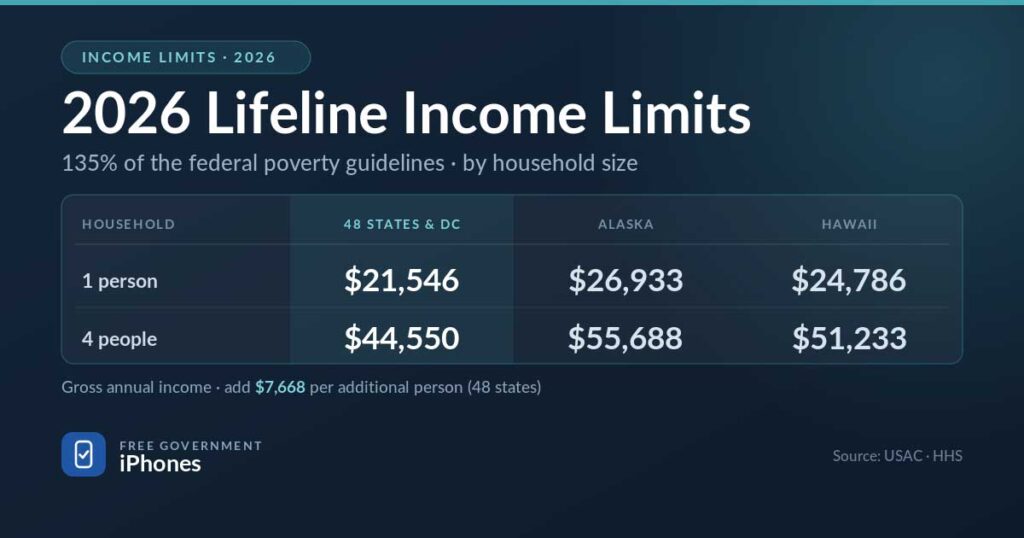
Table: Lifeline annual gross income limits, 2026 program year.
| Household size | 48 contiguous states, DC & territories | Alaska | Hawaii |
|---|---|---|---|
| 1 person | $21,546 | $26,933 | $24,786 |
| 2 people | $29,214 | $36,518 | $33,602 |
| 3 people | $36,882 | $46,103 | $42,417 |
| 4 people | $44,550 | $55,688 | $51,233 |
| 5 people | $52,218 | $65,273 | $60,048 |
| 6 people | $59,886 | $74,858 | $68,864 |
| 7 people | $67,554 | $84,443 | $77,679 |
| 8 people | $75,222 | $94,028 | $86,495 |
| Each additional person, add | $7,668 | $9,585 | $8,816 |
Living in Puerto Rico, the U.S. Virgin Islands, Guam, American Samoa, or the Northern Mariana Islands? Use the first column. HHS does not publish separate poverty guidelines for the territories, and USAC applies the contiguous-states figures there. Almost no other site tells you this, and people in the territories are routinely left guessing.
How we verified these numbers
We took the table from USAC’s consumer eligibility page, then independently recalculated every cell from the HHS 2026 poverty guidelines at 135%. All twenty-seven figures match, Alaska and Hawaii included.
An earlier version of this page declined to publish the Alaska and Hawaii rows for households of two or more, because we could only verify the single-person figures. USAC now publishes the full table for all three regions, so we can. That correction is logged on our corrections page.
Gross Income, Not Take-Home Pay
This is the single most common reason people misjudge their own eligibility — and it cuts in both directions.
Lifeline uses gross annual income: the total before tax, before health insurance, before retirement contributions, before anything is taken out. It is not the number that lands in your bank account.
The direction that costs people. Someone working part-time takes home about $1,600 a month — $19,200 a year, comfortably under the $21,546 single-person limit. But their gross is $23,400, which is over. They apply on income, get denied, and the denial feels arbitrary, because they used a real number that simply was not the one being measured.
Where to find your gross figure:
If your income comes from more than one place, add the gross figures together. All of them.
What Counts as Income
Lifeline uses gross annual household income for everyone in the household combined.
Generally counted
Generally not counted
Three distinctions that trip people up
SSDI is not SSI. They sound alike and they behave completely differently here. SSDI — Social Security Disability Insurance — counts as income toward your limit. SSI — Supplemental Security Income — is a qualifying program: if you receive SSI you skip the income test altogether. People conflate these constantly, and the cost is real — SSI recipients doing arithmetic they never needed to do, and sometimes talking themselves out of applying.
Social Security retirement counts. This is the most-searched version of this question, and the answer is yes: your gross annual benefit is income for Lifeline purposes. For many retirees living on Social Security alone, the benefit still falls under the limit.
VA disability compensation is not a Veterans Pension. The Veterans and Survivors Pension is a qualifying program — receive it and no income test applies. VA disability compensation is a different benefit and counts as income. Mixing these up sends people down entirely the wrong route.
If your income varies
Gig work, seasonal work, and irregular hours make this harder, and no official guidance makes it simple. Work out a realistic annual gross: add what you have actually earned so far this year and project forward honestly. Do not use your best month. Do not use your worst. If you are near the line, expect to be asked for documentation covering several months rather than a single snapshot.
The definitive rules are USAC’s, not ours. If your situation is genuinely unusual, call the Lifeline Support Center on (800) 234-9473 and ask before you assume.
Who Counts in Your Household
Household size is not “how many people sleep here.” For Lifeline, a household is everyone living at your address who shares income and household expenses — an economic unit, not a headcount. That is USAC’s own definition, and the operative word is shares.
Three worked examples
Two roommates splitting rent. Separate bank accounts, separate groceries, each paying their own share. These are two households at one address, and each may apply for their own benefit.
An adult child living with parents. She has a job, pays for her own phone, food, and car, and contributes a fixed sum toward rent without pooling finances. Likely a separate household — which matters enormously, because on her income alone she may qualify where the combined family income would not.
A multi-generational family sharing everything. Grandmother, two parents, three children, one grocery budget, pooled expenses. That is one household of six, so the figure to use is $59,886 in the contiguous states — not the single-person limit.
The most expensive mistake on this page
Undercounting your household is the single most common reason someone decides they do not qualify when they actually do. Every additional person raises your limit by $7,668. A household of four qualifies at more than double the income of a household of one.
If you support a child, a parent, or a partner, they count. Count everyone before you compare your income to the table.
The one-per-household rule
Only one Lifeline benefit is allowed per household — not per person, not per phone.
If more than one person at your address receives Lifeline, or you are applying at an address where someone already has it, you will be asked to complete a Lifeline Household Worksheet. That form is not an obstacle; it is the mechanism that lets genuinely separate households at one address each hold a benefit.
Be honest here. Claiming separate households where finances are genuinely shared tends to surface later, and it costs people the benefit entirely.
Proving Your Income — Expect to Be Asked
Here is something we have not seen published anywhere else, and it should change what you expect.
When you apply, the National Verifier checks your details automatically against government databases. For program-based eligibility this often works instantly — there are federal data connections for Medicaid, Federal Public Housing Assistance, and Veterans Pension, plus state connections for SNAP in roughly half the states.
For income, there is almost no automated verification anywhere. Working through USAC’s state-by-state table of data connections, income appears under manual verification in every state, district, and territory except one — Wisconsin. Wisconsin is the only jurisdiction with an automated income data connection.
So if you are applying on income, plan on uploading documents. It is not a sign that anything has gone wrong. It is the normal path for income applicants in 53 of 54 jurisdictions.
Documents that establish income: your prior year’s federal or state tax return, three consecutive months of recent pay stubs, a Social Security statement of benefits, an unemployment or workers’ compensation statement, a retirement or pension award letter, a divorce decree or child support award, or a Veterans Administration statement of benefits.
What gets uploads rejected: the name on the document must match the name on your application, pay stubs must be three consecutive months, and documents must be recent enough to reflect your situation now. Full rules are on our documents page.
How long review takes: documents submitted online during the Lifeline Support Center’s hours — 9 a.m. to 9 p.m. ET — are typically reviewed within minutes. Documents sent by mail take seven to ten business days for a decision.
If You Are Over the Limit
Do not stop there. Check these four things first.
- Recount your household. See above — this closes more gaps than anything else.
- Check you used gross, not net. People rule themselves out on take-home pay more often than on anything else.
- Check your actual annual income, not a good month multiplied by twelve. Last year’s tax return is the reference point, not your best recent payslip.
- Check the program route. If anyone in your household receives SNAP, Medicaid, SSI, a Veterans or Survivors Pension, Federal Public Housing Assistance, or a qualifying Tribal program, income is irrelevant — you qualify automatically. See qualifying programs.
If none of those apply, ask your internet or phone provider about their own low-income plans. Several operate wider income limits than Lifeline.
135% Is Probably Not the Number You Remember
If a benefits threshold is already in your head, it is likely the wrong one. Different programs use different multiples of the same poverty guidelines:
| Program | Income threshold |
|---|---|
| Lifeline | 135% of the poverty guidelines |
| SNAP (gross income test) | 130% |
| Medicaid (expansion states) | 138% |
| Affordable Connectivity Program (ended June 2024) | 200% |
The consequential one is the last. The ACP used a 200% threshold — far more generous than Lifeline’s 135%. Millions of households qualified for ACP on income at a level that does not qualify them for Lifeline.
If you had ACP and assumed Lifeline works the same way, check the table again. You may still be eligible through a qualifying program even if the income route has closed — but nothing will tell you that automatically. More in why the ACP ended and how the two programs compare.
When These Numbers Change
The Federal Poverty Guidelines are updated annually by HHS, normally published in January, with Lifeline’s 135% figures following. In practice the limits rise slightly each year.
This is why stale income tables are the most common error in this niche. A page showing 2024 numbers is not slightly out of date — it is quoting a limit hundreds or thousands of dollars from the real one, which is exactly the margin that decides a borderline case. Before trusting any income figure, including ours, look for the year and the date it was checked.
One genuinely unusual detail about the 2026 figures. The poverty guidelines are calculated by comparing average monthly CPI-U across two years. Because of the federal government shutdown in October 2025, the Bureau of Labor Statistics never published a CPI-U figure for that month. HHS therefore calculated the 2026 guidelines using the eleven available months of 2025 against all twelve months of 2024. The guidelines are entirely valid and HHS documented the method openly — but it is a useful reminder that there is machinery behind these numbers, and it occasionally has to improvise.
We re-check this page every February and update the date at the top. If you are reading this in a later year and the verification date looks stale, treat the numbers as indicative and confirm with USAC.
Common Questions
Is the limit based on gross or net income?
Gross — before tax and before deductions. USAC’s rule is “gross household income at or below 135% of the Federal Poverty Guidelines.” Use the figure before anything is taken out, not what lands in your bank account.
Does Social Security count as income for Lifeline?
Yes. Social Security retirement and survivors benefits count toward your gross household income. Many people receiving only Social Security still fall under the limit.
Does SSDI count? Is it the same as SSI?
They are different. SSDI counts as income. SSI is a qualifying program — if you receive SSI you are eligible regardless of income and do not need this table at all.
What is the Lifeline income limit for a family of four?
$44,550 in the 48 contiguous states, DC, and the territories. $55,688 in Alaska. $51,233 in Hawaii. Those are 2026 figures.
Does my spouse’s income count if we file taxes separately?
Yes, if you live together and share income and expenses. Lifeline’s household definition is about shared finances, not tax filing status.
Do my roommates count as part of my household?
Only if you share income and household expenses. Roommates who split rent but keep separate finances are separate households, and each may apply. You may be asked to complete a Household Worksheet.
I only just started a new job. Which income do I use?
Your current annual household income, projected honestly. If you have been earning at the new rate for less than a year, the National Verifier will generally want three consecutive months of recent pay stubs, which reflects your actual current position.
Do I have to prove my income?
If you qualify through a program like SNAP or Medicaid, generally no. If you qualify on income, almost certainly yes — income is manually verified everywhere except Wisconsin. See documents needed.
Are the income limits different in Alaska and Hawaii?
Yes, and meaningfully so. Both have higher limits, because HHS publishes separate poverty guidelines for them. See the table above.
What if my income changes during the year?
Apply when you qualify. If your income later rises above the limit, tell your provider. You keep the device and can move to standard rates, and you can reapply if your circumstances change again.
Check Your Own Position
Our eligibility checker does the arithmetic for you, including household size and region, and tells you which route applies.
Run the eligibility checker → · Read the full eligibility rules → · How to apply, step by step →
Sources
Verification
Page last verified: July 2026. Income limits update annually, usually in January or February — we re-check this page then. Found an error? Tell us, and we will log it publicly on our corrections page.